Businesses are using artificial intelligence to improve customer service, generate leads, automate repetitive tasks, and save time. But as AI technology continues to evolve, one question comes up again and again:
What’s the difference between a chatbot and an AI agent?
At first glance, they might look similar. Both can communicate with users, answer questions, and help businesses improve their online experience. However, the way they work is quite different.
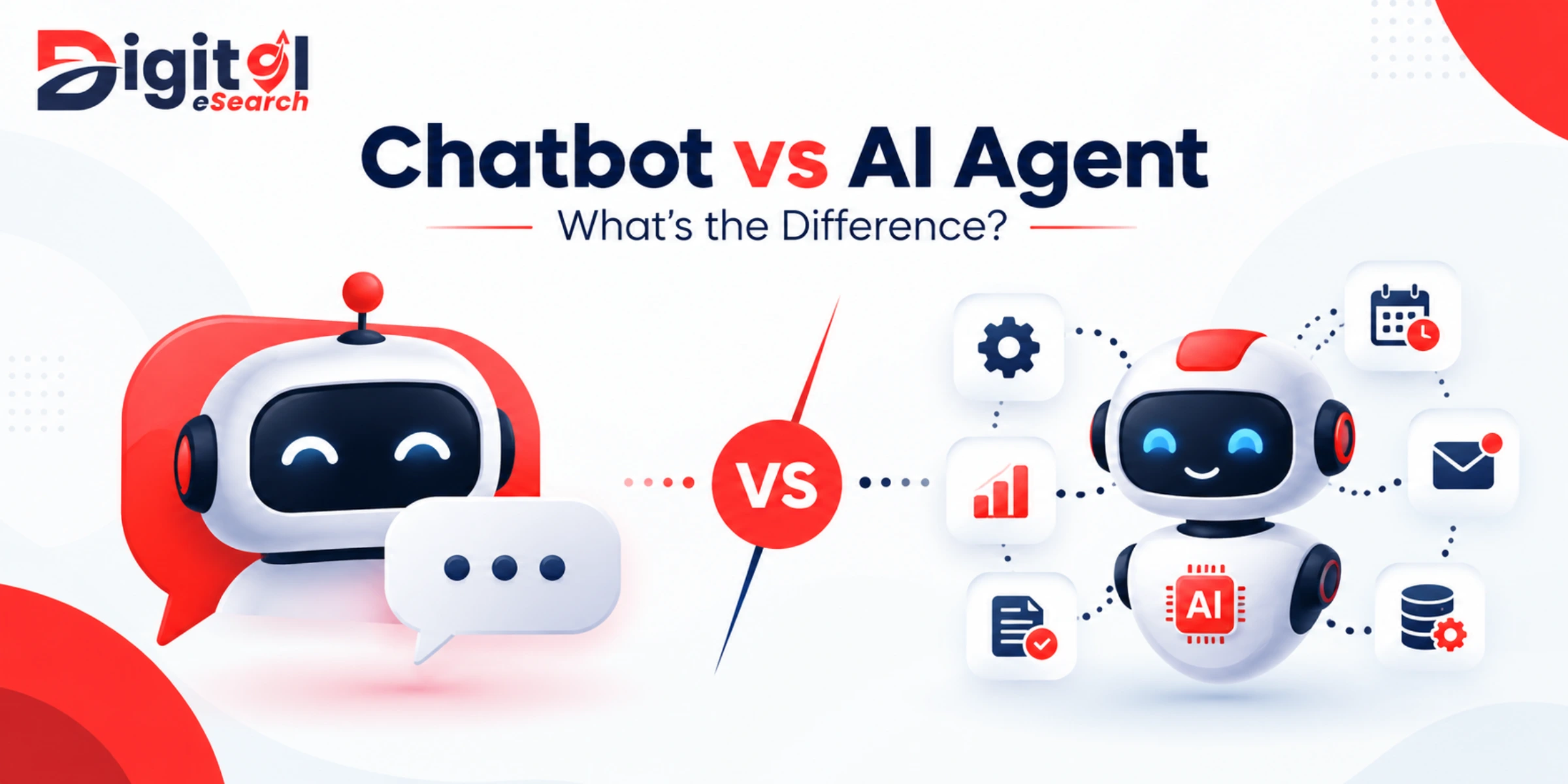
A traditional chatbot mainly responds to user questions based on predefined rules or programmed workflows. An AI agent can go a step further by understanding a goal, deciding which actions to take, using connected tools, and completing multi-step tasks with an appropriate level of autonomy.
For businesses looking to improve efficiency, customer experience, and digital growth, understanding this difference can help them make smarter technology decisions.
In this guide, Digital eSearch explains chatbots vs. AI agents in simple language, with real-world examples, business applications, advantages, limitations, and practical tips to help you choose the right solution.
What Is a Chatbot?
A chatbot is a software application designed to communicate with people through text or voice. Businesses commonly use chatbots on websites, messaging platforms, and customer support channels to answer questions and provide information.
Traditional chatbots often follow predefined rules, keywords, buttons, or decision trees. More advanced chatbots use natural language processing and large language models to understand questions and generate more natural responses.
For example, imagine a customer visiting your website and asking:
“What are your digital marketing services?”
A chatbot can respond with information about your SEO services, Google Ads management, social media marketing, and other offerings.
If the chatbot is connected to a knowledge base, it may also answer questions about pricing, service processes, and frequently asked questions.
How Does a Chatbot Work?
A typical chatbot follows a straightforward process:
- Receives a message: A visitor asks a question or selects an option.
- Processes the input: The chatbot identifies the user’s intent or interprets the message using an AI model.
- Generates a response: It retrieves information or provides an answer based on its configuration and available data.
- Continues the conversation: It answers follow-up questions or directs the user to the next step.
The exact process depends on whether the chatbot is rule-based, AI-powered, or a combination of both.
Common Uses of Chatbots
Businesses use chatbots for several purposes, including:
- Answering frequently asked questions.
- Providing basic customer support.
- Sharing product and service information.
- Collecting contact details from potential customers.
- Helping visitors navigate a website.
- Booking appointments through connected systems.
- Providing information outside normal business hours.
Example: A visitor asks your website chatbot, “Do you provide local SEO services?” The chatbot explains the service and offers a link to your Local SEO page or a contact form.
It’s a useful way to engage website visitors without requiring a team member to answer every basic question manually.
What Is an AI Agent?
An AI agent is an AI-powered system that can work toward a defined goal by interpreting information, making decisions within its configured boundaries, and taking actions using available tools.
Unlike a chatbot that primarily focuses on conversations, an AI agent can combine conversation with task execution.
For example, imagine a potential customer asks:
“I want to improve my website’s Google rankings. Can you help me identify the main SEO issues?”
A basic chatbot might explain common SEO problems and recommend an audit.
An AI agent with the right integrations and permissions could go further. It might collect the website URL, run an authorized website audit, analyze the results, prioritize technical issues, prepare a report, and share recommended next steps.
The important difference is that the agent is not just providing information. It is working through a series of actions to achieve a specific outcome.
How Does an AI Agent Work?
An AI agent generally follows a goal-oriented process:
- Understands the objective: It identifies what the user wants to accomplish.
- Plans the next steps: It determines which actions or tools may be required.
- Uses available tools: It may interact with APIs, databases, websites, or business applications.
- Evaluates the results: It checks the information returned and decides what to do next.
- Completes or escalates the task: It provides the result, requests approval, or asks a human for help when necessary.
Not every AI agent uses every step, and the degree of autonomy varies. Some agents handle simple workflows, while others can coordinate complex tasks across multiple systems.
Common Uses of AI Agents
AI agents can support a wide range of business activities:
- Automating repetitive business workflows.
- Researching information and preparing summaries.
- Analyzing website performance and SEO data.
- Qualifying leads using defined criteria.
- Updating CRM records through approved integrations.
- Coordinating customer support tasks.
- Generating reports from connected business systems.
- Supporting marketing campaign analysis and optimization.
Example: An AI agent for a digital marketing agency could collect approved campaign data, compare performance against targets, identify underperforming campaigns, and prepare recommendations for a marketing specialist to review.
This can reduce manual work and help teams focus on strategy, creativity, and decision-making.
Chatbot vs. AI Agent: What’s the Difference?
The biggest difference between a chatbot and an AI agent is their primary purpose.
A chatbot is mainly designed to communicate with users. An AI agent is designed to pursue a goal and may take actions to accomplish it.
Here’s a quick comparison.
| Feature | Chatbot | AI Agent |
|---|---|---|
| Primary purpose | Answer questions and communicate | Complete tasks and achieve goals |
| Working approach | Rules, workflows, retrieval, or AI responses | Goal-oriented reasoning and action |
| Decision-making | Often limited to configured flows or responses | Can select actions within defined boundaries |
| Tool usage | May retrieve information or trigger integrations | Can coordinate multiple tools and systems |
| Task execution | Often handles individual interactions | Can manage multi-step workflows |
| Adaptability | Depends on its design and underlying AI | Can adjust actions based on results and context |
| Human involvement | Needed for complex or sensitive issues | Needed when approval, judgment, or escalation is required |
| Typical example | Answering FAQs on a website | Investigating a request and executing an approved workflow |
| Best suited for | Customer conversations and information delivery | Workflow automation and task completion |
One important point: the distinction is not simply that chatbots follow rules and AI agents think independently. Modern chatbots can use advanced AI, and AI agents can also operate within strict rules. The key difference is the system’s ability to plan and execute actions toward a goal.
Real-World Examples: Chatbot vs. AI Agent
Let’s look at how the two technologies might work in everyday business situations.

1. Customer Support
Chatbot: Answers questions about delivery, returns, business hours, or services.
AI agent: Can investigate an order issue using authorized systems, check the relevant status, initiate an eligible workflow, and escalate exceptions to a support representative.

2. Digital Marketing and SEO
Chatbot: Explains SEO concepts, suggests keywords, and answers questions about digital marketing services.
AI agent: Can analyze connected SEO data, identify potential opportunities, organize findings by priority, and prepare a report for a specialist to review.

3. Sales and Lead Generation
Chatbot: Collects a visitor’s name, email address, and service requirements.
AI agent: Can qualify the lead against agreed criteria, update a connected CRM, assign the lead to the appropriate team, and prepare a personalized follow-up for approval.

4. Business Operations
Chatbot: Provides information about internal policies and procedures.
AI agent: Can coordinate an approved multi-step workflow, such as collecting information, creating a task, notifying the responsible team, and recording the outcome.
These examples demonstrate how both technologies can be useful. The right choice depends on the problem you want to solve, the tools available, and the level of automation your business needs.
Can a Chatbot Also Be an AI Agent?
Yes, but not every chatbot is an AI agent.
A chatbot can serve as the conversational interface for an AI agent. In this setup, the user communicates through a chat window while the agent performs tasks in the background.
For example, a website visitor might type:
“Please analyze my website and tell me what is stopping it from ranking better on Google.”
A simple chatbot might provide general SEO advice.
An AI-powered chatbot connected to an agentic workflow could collect the URL, run an authorized analysis, retrieve relevant performance data, identify issues, and produce a customized report.
The interface looks like a chatbot, but the underlying system performs agent-like actions.
This is why the terms are sometimes used interchangeably, even though they describe different capabilities.
Think of it this way: A chatbot is often the conversation layer. An AI agent is the task-execution layer. A single system can include both.
Benefits of Chatbots for Businesses
Chatbots can be a practical starting point for businesses that want to improve customer communication without introducing complex automation.
1. Faster Customer Responses
Chatbots can answer common questions immediately, reducing the need for visitors to wait for a team member.
2. Better Website Engagement
A well-designed chatbot can help visitors find the right service page, understand an offering, or navigate to a contact form.
3. Lead Generation Support
Chatbots can ask relevant questions and collect contact information when users choose to provide it.
4. Consistent Information
When configured with reliable, up-to-date content, chatbots can provide consistent answers about business services and policies.
5. Reduced Repetitive Work
By handling routine enquiries, chatbots can free employees to focus on more complex customer needs.
For small and medium-sized businesses, a chatbot can be a cost-effective way to improve the online customer experience.
Benefits of AI Agents for Businesses
AI agents can provide additional value when a business needs more than conversations and basic responses.
1. Automate Multi-Step Tasks
An AI agent can coordinate several actions within a workflow rather than requiring employees to complete each step manually.
2. Improve Operational Efficiency
When connected to appropriate systems, agents can reduce repetitive data entry, information gathering, and report preparation.
3. Support Data-Driven Decisions
Agents can analyze information from connected sources and highlight trends, anomalies, or opportunities for human review.
4. Connect Different Business Tools
With suitable integrations and permissions, an agent can work across CRM platforms, analytics tools, project management systems, and other business applications.
5. Personalize Business Workflows
An agent can adapt its actions to the information available, the user’s objective, and the rules established by the business.
However, AI agents are not automatically more accurate or more effective than chatbots. Their performance depends on the quality of the data, the tools they can access, the workflow design, and the safeguards in place.
Chatbot vs. AI Agent: Which One Is Better for Your Business?
There is no single winner. The right option depends on what you need the technology to do.
Choose a chatbot if…
- You need to answer frequently asked questions.
- Your website receives repetitive customer enquiries.
- You want to direct visitors to relevant pages or services.
- You need a simple lead collection workflow.
- You want to start with a clearly defined use case.
Choose an AI agent if…
- You need to automate tasks involving several steps.
- Your team spends significant time gathering and organizing data.
- Your workflows require interaction with multiple connected tools.
- You need systems to evaluate results and choose the next action.
- You want to automate defined processes with appropriate oversight.
Consider a combination if…
- You want a conversational website experience backed by task automation.
- Customers need to ask questions and complete eligible actions.
- Your business wants to combine customer support, lead qualification, and internal workflows.
For many businesses, the smartest approach is to start with a specific problem, measure the results, and expand automation only when it demonstrates clear value.
How Digital eSearch Can Help Businesses Use AI More Effectively
At Digital eSearch, we understand that technology should support real business goals—not simply follow the latest trend.
Whether your objective is to attract more qualified visitors, improve website engagement, or build a more efficient digital marketing process, understanding AI technology can help you make better decisions.
Here are some areas where businesses can explore AI alongside their digital marketing strategy.
AI for SEO and Content Marketing
AI tools can help marketing teams research topics, organize keywords, identify content gaps, and analyze search intent. AI agents can potentially coordinate parts of these workflows using approved tools and reliable data.
Human expertise remains important for content accuracy, originality, brand voice, and strategic decisions.
AI for Lead Generation
Chatbots can help visitors understand your services and submit enquiries. More advanced agent-based workflows can help qualify leads, organize information, and route enquiries to the right team.
The goal is to turn relevant website traffic into meaningful business opportunities.
AI for Marketing Automation
Connected AI workflows can help organize campaign data, summarize performance, identify areas for investigation, and prepare reports.
Any changes involving advertising budgets, campaign settings, customer records, or external communications should have suitable permission controls and human approval where appropriate.
AI and Search Visibility
As search experiences increasingly include AI-generated answers, businesses need clear, useful, trustworthy content that answers genuine user questions.
That means focusing on search intent, accurate information, logical content structure, relevant internal links, and helpful explanations—not simply adding AI-related keywords to a page.
For businesses investing in digital growth, AI should complement a strong SEO strategy rather than replace it.
How to Get Started With Chatbots and AI Agents
If your business is considering chatbot or AI agent technology, follow these practical steps.
- Identify a real business problem. Start with a repetitive customer enquiry or a time-consuming internal task.
- Choose the right solution. Use a chatbot for straightforward conversations and an agent when the workflow requires goal-oriented actions.
- Connect reliable information. Make sure the system has access only to the data and tools it needs.
- Set clear boundaries. Define what the system can do independently and which actions require approval.
- Test with real scenarios. Evaluate accuracy, completion rates, user experience, and failure cases.
- Measure business outcomes. Track relevant metrics such as response time, qualified leads, task completion, customer satisfaction, and cost per outcome.
- Improve gradually. Use the results to refine the workflow before expanding its responsibilities.
A small, well-designed automation can be more valuable than a complicated AI system that does not solve a clear business problem.
Challenges and Limitations to Consider
Both chatbots and AI agents have limitations, and businesses should understand them before implementation.
- Incorrect answers: AI systems can produce inaccurate or misleading information.
- Limited context: Systems may misunderstand vague requests or lack access to important details.
- Integration requirements: Agentic workflows may require APIs, permissions, data preparation, and ongoing maintenance.
- Privacy and security: Customer information must be handled appropriately, with access limited to authorized purposes.
- Unexpected actions: Agents with excessive permissions can create operational risks.
- Human oversight: Sensitive decisions and unusual situations may require human judgment.
To reduce these risks, use reliable knowledge sources, test thoroughly, apply least-privilege access, maintain activity logs where appropriate, and require human approval for high-impact actions.
The objective is not to remove people from every process. It is to help people work more effectively while maintaining accountability.
Final Thoughts
The difference between a chatbot and an AI agent comes down to what the system is designed to accomplish.
A chatbot helps people communicate with your business, find information, and get answers. An AI agent can go further by using tools and carrying out actions to complete a defined task.
Both can be valuable. The right choice depends on your business goals, workflow complexity, available data, and the level of control you need.
For businesses looking to improve digital performance, the opportunity is not simply to adopt AI. It is to use the right technology to solve real problems, improve customer experiences, and create measurable value.
At Digital eSearch, we believe successful digital growth starts with the right strategy. Whether you’re exploring AI-powered workflows, improving your website’s search visibility, or looking for better ways to generate qualified leads, focus on solutions that deliver meaningful results.
Ready to improve your digital strategy? Explore our digital marketing services and discover how a smarter approach can support your business growth.